Texas Is the New Center of American Politics. Just Look at Trump’s Appointees.

It’s old hat to say everything is bigger in Texas. True connoisseurs know that things in the Lone Star State are also often wilder and weirder than what you see on the evening news. Every two weeks, Steven Monacelli will explore the dystopic, desperate, and despicable realities of contemporary Texas and channel the sense of absurdity, anger, and anguish that is felt by so many Texans. State politics mirror our already overheated summers, while floods and hard freezes overwhelm our infrastructure, and disinformation erodes our social discourse. But not all is lost. Together, we can navigate this Hell & High Water to get to more stable ground.
As liberals and progressives reflect on their shocking electoral defeat — and fight to assign blame for the loss — former and future President Donald Trump has been busy making cabinet nominations and urging Congress to allow his administration to push through recess appointments. The nominees include an anti-vaccination and anti-fluoridation activist as the head of the Department of Health and Human Services, a TV news commentator with Christian nationalist tattoos for the head of the Department of Defense, a fracking company CEO for the head of the Department of Energy, and a congressman who is facing an ethics probe (regarding sex trafficking) for the United States Attorney General.
Among the most telling announcements was also the most unusual: Trump appointed Elon Musk and Vivek Ramaswamy to lead the Department of Government Efficiency, a newly created group whose name belies the fact that it is not an official government department but shares an acronym with a cryptocurrency of which Musk owns a large amount — and which has spiked in price since the announcement of the organization. (Anyone heard from the Office of Government Ethics lately?)
Following Musk’s lead in moving his business(es) to Texas, Ramaswamy recently announced the relocation of his “anti-woke” financial services and wealth management firm Strive to Dallas. Their nomination to lead the Department of Government Efficiency provides new evidence to support my pet political theory: The center of political gravity in the United States is closer to Dallas than Washington, D.C. or Silicon Valley.
The source of funding and the exact scope of powers bestowed upon the Department of Government Efficiency are unclear. There are more questions than answers about how it will operate. As outside advisers, it is uncertain whether Musk and Ramaswamy will be subject to the same financial disclosures and transparency requirements as public sector employees. But it is clear that the two billionaires will lead an organization with a sweeping mandate to cut costs across the federal government, work that could directly impact their business interests.
An oligarchy is a power structure in which the few dominate the many. Several scholars have argued that the U.S., nominally a representative democracy, is oligarchic in nature and has become more so with the legalization of unlimited political donations following the 2010 Citizens United v. FEC Supreme Court decision. One definition of an oligarch is “a very rich business leader with a great deal of political influence.” Under that framework, Trump has empowered two oligarchs whose businesses are headquartered in Texas.
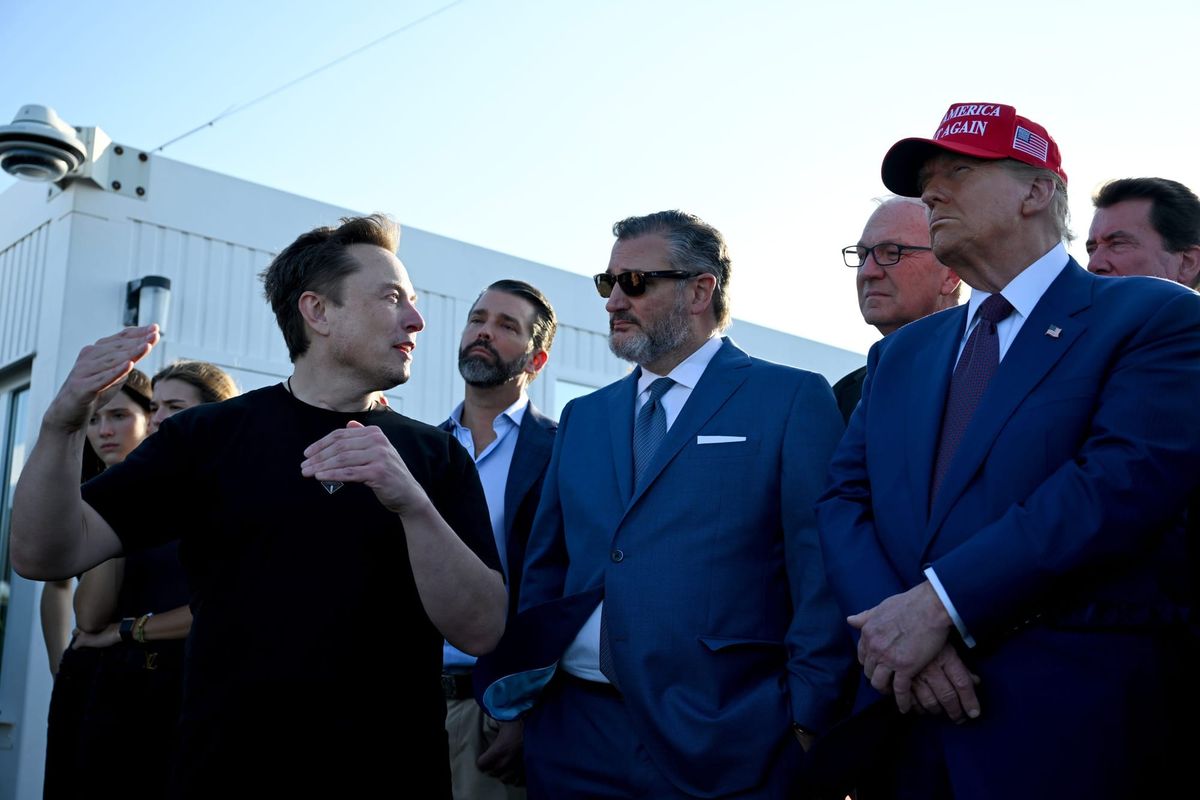
It’s important, too, to note that Trump hasn’t just empowered Musk: There isn’t even “a close second” in the president-elect’s inner circle. Trump has put Musk — dubbed by Axios as “the most powerful (unelected) man ever” — on calls with heads of state, diplomats, and spent nearly every waking moment with the man since Election Day. Trump even traveled down with Musk to watch a test flight at SpaceX in the Rio Grande Valley on Wednesday.
Of course, Musk and Ramaswamy aren’t the only Texas-adjacent moguls whose support of Trump could translate to profit under Trump’s policy platform, which includes proposed tax cuts for the wealthy. According to Open Secrets, 60 of the top 100 political donors at the federal level in 2024 donated primarily to Republicans. Nine of the top 100 donors are from Texas, and they all give almost exclusively to Republican candidates and conservative causes, making up more than $215 million in contributions — including $133 million from Musk and $35 million from Christian nationalist kingmaker Tim Dunn.
Only one state, Illinois, was a greater source of conservative megadonor cash than Texas. And that’s not including Texas-adjacent billionaire MAGA megadonors donors like Las Vegas casino mogul and now Dallas Mavericks majority stakeholder Miriam Adelson, who spent more than $136 million to bolster Trump, Sen. Ted Cruz, and other Republican candidates — and whose impact on Texas politics is already being felt. Then there’s the quieter influence of Harlan Crow, the Dallas real estate magnate who secretly lavished favors upon Supreme Court Justice Clarence Thomas while having a stake in cases that went before the court.
It’s not just that Texas is home to influential advisors who stand to profit off their advice and Republican megadonors who helped secure Trump’s electoral victory. Texas carries 40 electoral college votes and 38 seats in the House — and it stands to gain even more after the 2030 census, if California keeps losing residents. It is the largest Republican dominated state in the nation, the second largest state in terms of economy and population, the eighth largest economy in the world, and is on the bleeding edge of far-right politics. When it comes to some of Trump’s key priorities like mass deportation; “drill, baby, drill;” dismantling public education in favor of school privatization; or abortion rights, Texas will play a central role or serve as a role model. This week, Texas Land Commissioner Dawn Buckingham offered the incoming Trump administration a 1400-acre plot of land “to construct deportation facilities.” Nobody’s courting Trump like Texas officials.
To that end, other state-level political happenings may help predict what’s to come nationally: the deployment of the Texas National Guard as a border enforcement force; our loose environmental protections around oil drilling sites; and the potentially largest school voucher program in the country. Our ethically challenged attorney general, Ken Paxton, has set an example that the United States Attorney General may follow. Paxton may not have been nominated for the top law job in the country — for which he had apparently been auditioning — but Trump picked another ethically embroiled candidate: Florida congressman and alleged sex trafficker Matt Gaetz. Even if Paxton is out of the running, it doesn’t mean Gaetz or whomever is confirmed will not take a page out of his book and weaponize the office against political opponents — and few are as prolific as Paxton, who has sued the Biden-Harris administration more than 100 times, over everything from lizards to children.
As one Texas Monthly headline put it: Under a second Trump administration, America could look a lot like Texas. For people to understand American politics, they will need to understand Texas politics. This makes it all the more imperative that we continue to shine a light in dark places.