Judge Blocks Texas Law Requiring Ten Commandments in Classrooms, Calling It Religious ‘Coercion’

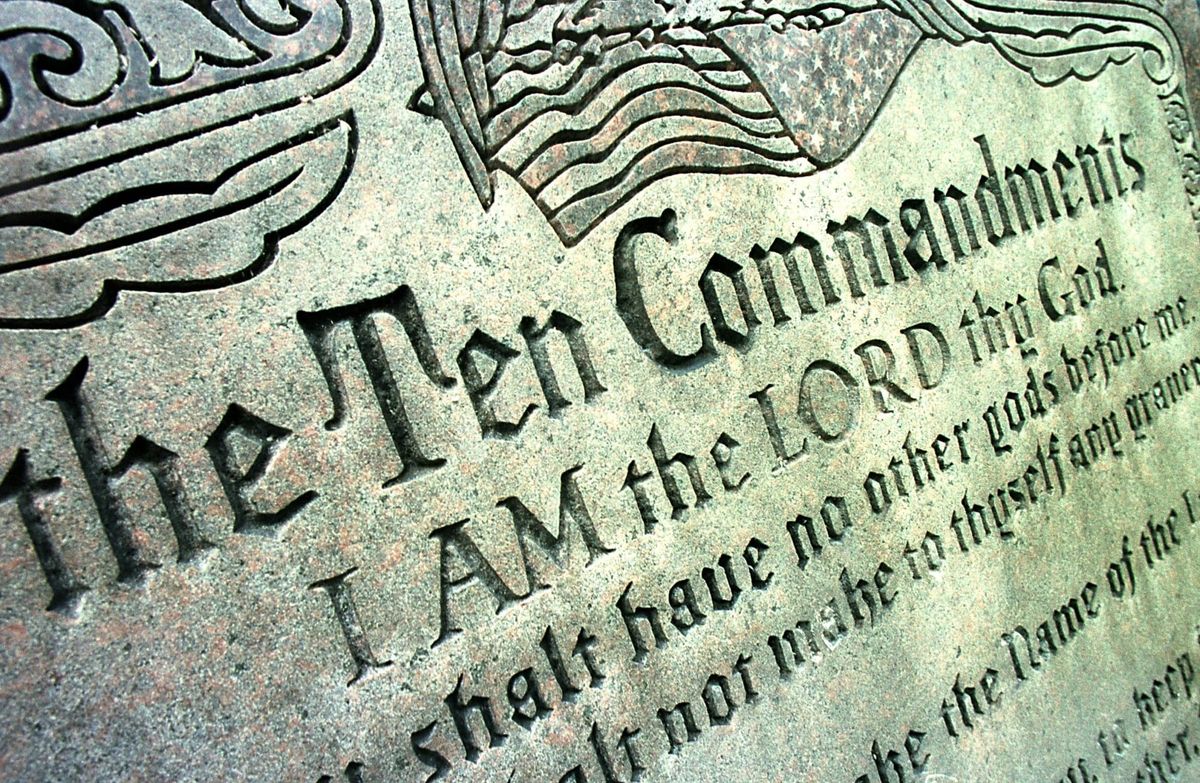
A federal judge in San Antonio issued a ruling on Wednesday temporarily halting the controversial Texas law that would require all public schools to display donated posters of the Ten Commandments in every classroom.
In a comprehensive, sometimes cheeky 55-page ruling first reported by The Houston Chronicle, U.S. District Judge Fred Biery sided with several faith leaders and 16 parents who sued the state claiming the requirement harmed their children’s religious development.
The faith leaders and families were represented by the American Civil Liberties Union of Texas and other religious freedom organizations, reported Texas Tribune, which noted that Biery’s ruling only applies to the 11 school districts named in the lawsuit.
In a statement on Wednesday, the ACLU called the ruling “a victory for religious freedom and church-state separation.”
Senate Bill 10, which was authored by state Sen. Phil King of Weatherford, passed during the last legislative session at the Texas Capitol. It declared that public schools must display either a 16-by-20-inch poster or a framed copy of the Ten Commandments in every classroom. It was signed into law by Gov. Greg Abbott in June — despite a ruling one day earlier from the 5th U.S. Circuit Court of Appeals that found similar legislation in Louisiana to be “plainly unconstitutional” — and would have gone into effect on Sept. 1.
“The Supreme Court has held that the posting of the biblical Ten Commandments on a public school wall is unconstitutional,” wrote Biery, who ruled that “S.B. 10 crosses the line from exposure to coercion.”
“There are ways in which students could be taught any relevant history of the Ten Commandments without the state selecting an official version of scripture, approving it in state law, and then displaying it in every classroom on a permanent basis,” he continued.
But as the law is currently written, it’s likely, Biery wrote, that “minor-child Plaintiffs, will be unconstitutionally coerced into religious observance, meditation on, veneration, and adoption of the state’s favored religious scripture, and they will be pressured to suppress expression of their personal religious and nonreligious beliefs and practices, especially in school, to avoid the potential disfavor, reproach, and/or disapproval of school officials and/or their peers.”
In his ruling, Biery also seemed to be aware that he was stepping into the political fray.
“For those who disagree with the court’s decision and who would do so with threats, vulgarities and violence,” he wrote, “grace and peace unto you. May humankind of all faiths, beliefs and non-beliefs be reconciled one to another.”
As for the plaintiffs, Rabbi Mara Nathan said in a statement on Wednesday: “Children’s religious beliefs should be instilled by parents and faith communities, not politicians and public schools.”
“It is gratifying to see the federal court honoring our First Amendment, with the wisdom to understand how wrong it would be to impose bible edicts on public students as young as kindergartners,” said Annie Laurie Gaylor, co-president of the Freedom From Religion Foundation, also in a statement.
There’s little doubt that this will be a relief to teachers in the dozen Texas school districts where Biery’s ruling applies. At best, schools were confused about how to implement the law ahead of the academic year, The Dallas Morning News previously reported.
Brinda Gurumoorthy, a math teacher at Sunset High School in Dallas, told the newspaper that instructing students on religion is simply not part of her job — and a role she isn’t comfortable with.
“Religious belief isn’t really my job to instruct students, that’s between them and their family or them and their church,” Gurumoorthy reportedly said. “I feel like it would be inappropriate to include.”
In his ruling, Biery agreed.
For teachers specifically, Biery noted that while the Ten Commandments wouldn’t be “affirmatively taught,” teachers would “feel compelled to answer” the likely questions that would come up, calling it a “classic example of the law of unintended consequences in legislative edicts” and one that is unfair to “overworked and underpaid educators.”
Biery also noted that “children can be cruel to their classmates perceived to be ‘the other.’”
“Ultimately, in matters of conscience, faith, beliefs and the soul, most people are Garbo-esque,” Biery wrote, referencing a 1932 film line spoken by actress Greta Garbo. “They just want to be left alone, neither proselytized nor ostracized, including what occurs to their children in government-run schools.”
In his ruling, Biery even offered some alternatives to the Ten Commandments, should legislators feel compelled to provide moral teachings in public school classrooms.
He wrote, “to avoid religious rancor and legal wrangling,” the Texas Legislature could mandate any other commonly accepted best-practices or shorthands, including the Moral Precepts of Buddhism — “abstain from killing, stealing, engaging in sexual misconduct, lying, and intoxicants” — and the classic Golden Rule of “do unto others as you would have them do unto you.”
He even provided the teachings of “All I Really Need to Know I Learned in Kindergarten” as an example, which includes “clean up your own mess” and “don’t take things that aren’t yours.”
Frankly, we could all use some of these reminders — and not just in schools.