We Should All Be Concerned About the Rhetoric Coming Out of Trump’s Orbit

It’s old hat to say everything is bigger in Texas. True connoisseurs know that things in the Lone Star State are also often wilder and weirder than what you see on the evening news. Every two weeks, Steven Monacelli will explore the dystopic, desperate, and despicable realities of contemporary Texas and channel the sense of absurdity, anger, and anguish that is felt by so many Texans. State politics mirror our already overheated summers, while floods and hard freezes overwhelm our infrastructure, and disinformation erodes our social discourse. But not all is lost. Together, we can navigate this Hell & High Water to get to more stable ground.
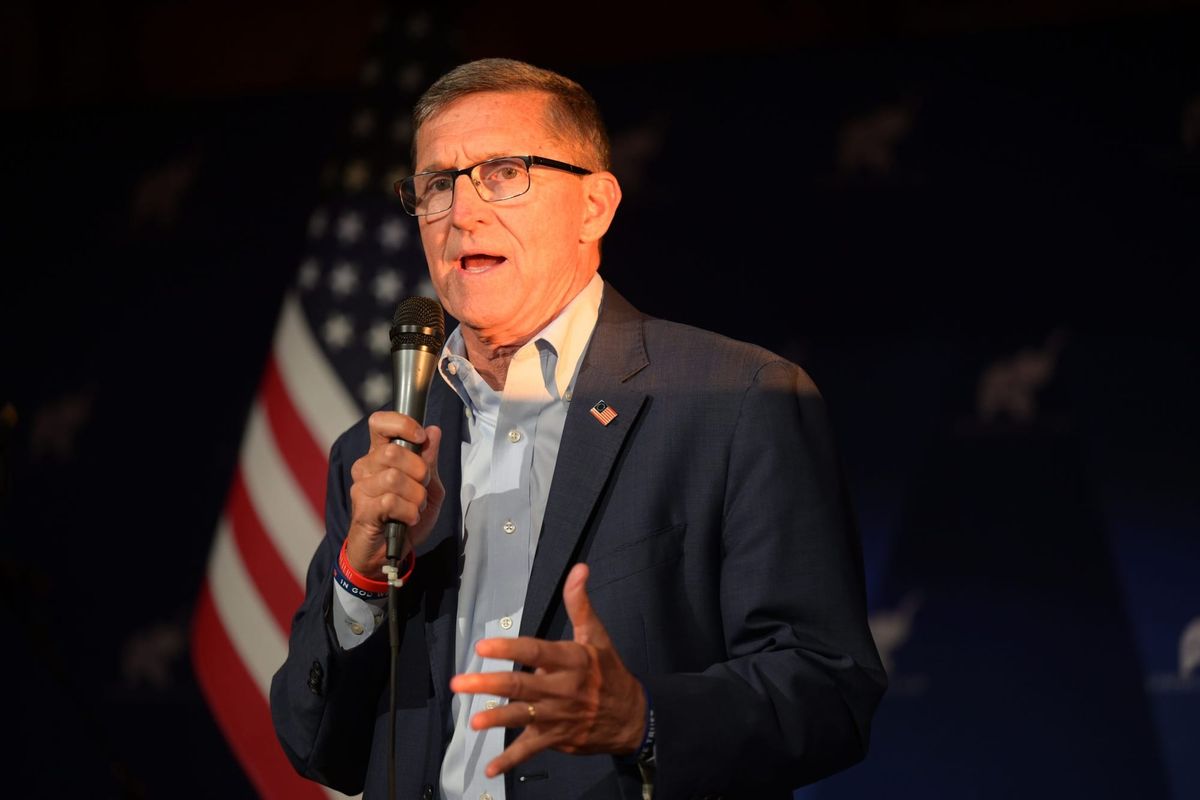
Retired Army lieutenant general Michael Flynn was on stage at a QAnon convention in Dallas, Texas, in 2021 when I heard him make a disturbing comment in response to a question from an audience member, who asked why “what happened in (Myanmar) can’t happen here,” regarding a recent coup in the country, also known as Burma.
“No reason. I mean, it should happen here,” Flynn said. “No reason. That’s right.”
Flynn’s comment drew widespread scrutiny, including from the then chairman of the Texas Republican Party, Allen West, who was among at least three prominent Texas GOP officials who took part in the event.
“I do not support any type of military coup in the United States of America because we have a representative democracy, we have a constitutional republic, and we just need to abide by the Constitution in all that we say and do,” West said in an interview with Newsmax following the event.
Now, years later, Flynn — who served as national security advisor for the Trump administration — and others in the broader Trump universe are still speaking in alarming tones — including the former president himself.
While at the Rod of Iron Freedom Festival, a Christian nationalist event in Pennsylvania held this October, Flynn was asked whether he would “get [his] rank reinstated and sit at the head of a military tribunal to not only drain the swamp but imprison the swamp — and, on a few occasions, execute the swamp?”
Flynn responded by saying “we need accountability” and later closed his remarks by saying that if Trump wins, “the gates of hell — my hell — will be unleashed.”
Meanwhile, former president Donald Trump said in an October interview that if “radical left lunatics” cause disruption, those “enemies from within…should be very easily handled by, if necessary, by National Guard, or if really necessary, by the military, because they can’t let that happen.” He also described the events of Jan. 6, 2021 as a “day of love” during an October town hall.
Then there’s Ivan Raiklin, a conservative political activist and self-described “future secretary of retribution” under Trump. Raw Story reported he’s circulated a list of 350 people he wants arrested with the help of so-called “constitutional sheriffs.”
These sorts of statements present parallels to the historic rise of other authoritarian leaders, and they should disturb us all. Ruth Ben-Ghiat, a professor of history and Italian studies at New York University, has repeatedly made comparisons between Trump and World War II-era dictators on social media.
“Once again, just like Mussolini, who promised, the day he declared dictatorship, to give Italy peace ‘through love, if possible, and through force, if necessary,’” Ben-Ghiat wrote regarding Trump’s comments about January 6.
The problem now, and historically, is that many people believe that these sorts of statements aren’t serious. Take it from Jason Stanley, a Yale University professor and the author of “How Fascism Works,” who told Rolling Stone: “It’s a very common theme in the history of fascism that lots of people think that the fascist leader is joking. People don’t want to believe what’s right in front of their eyes. Let’s take Trump seriously this time.”
Trump’s allies have downplayed criticisms like those from Ben-Ghiat and Stanley, pointing to the fact that Trump never had former secretary of state Hillary Clinton arrested despite his invocation of the call to “lock her up.” Comforting as that isn’t, the violent rhetoric about retribution against perceived political enemies is playing out in front of a backdrop of increasing militancy and threats regarding our electoral processes.
A recent report from WIRED uncovered a shocking revelation: “United States intelligence officials have been quietly issuing warnings to government agencies all summer about a rising threat of extremist violence tied to the 2024 presidential election, including plots to destroy bins full of paper ballots and promote ‘lone wolf’ attacks against election facilities throughout the country.”
And it’s not just perceived political enemies that Trump has said he intends to punish. He has pledged to pursue a policy of mass “remigration,” an alarming term with associations to fascist politics that dovetails with the similarly fascistic “great replacement theory.” Such philosophies posit the white population of America is intentionally being replaced by immigrants of color. To prevent this, Trump has said he would use the National Guard and possibly the military. As Michael Hardy recently wrote for Texas Monthly, Trump’s “remigration” plan mirrors how Gov. Greg Abbott has turned the Texas Army National Guard into his private border security force. Abbott has also deployed State Troopers to crush pro-Palestinian protests on college campuses across the state where left-leaning protesters have been deemed disruptive.
There’s an old saying: “As Texas Goes, So Goes the Nation.” And if Trump is indeed taking a page out of the Texas Republican playbook, there is real reason to be concerned that the rhetoric coming out of Trump’s world is no joke.