Texas Is a Testing Ground for Federal Anti-Abortion Policies

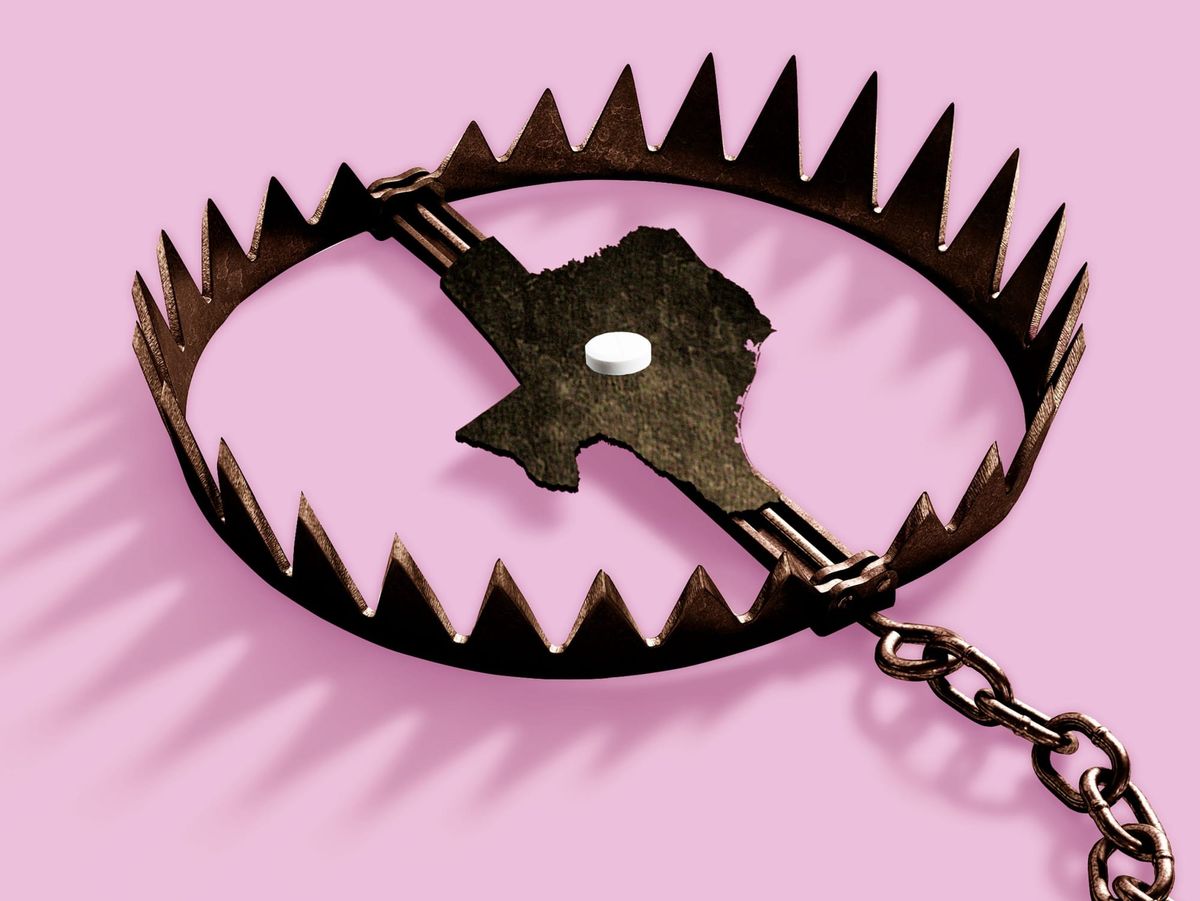
Abortion medication classified as controlled substances.
Internet providers prosecuted for hosting abortion information.
Abortion advocates charged with racketeering.
The death penalty for abortion patients.
That’s a glimpse of abortion-related bills filed in the 89th Texas Legislature as the session nears its half-way point. It’s also a glimpse at the future of reproductive healthcare in Texas — one that Texas Attorney General Ken Paxton signaled this week is more probable than it may have seemed at the session’s outset.
On Monday, Paxton announced the arrest of a Houston-area midwife. Maria Margarita Rojas, who Paxton’s office called “Dr. Maria,” was charged with illegally providing abortions, in addition to practicing medicine without a license, according to a press release from Paxton’s office.
It is the first time criminal charges have been filed under the state’s near total abortion ban.
When reached by phone by reporters from the Houston Chronicle, an employee at Rojas’ Cypress location, who declined to provide their name, told the newspaper that abortions are not performed at the clinic. “No. Not at all. That’s all a lie,” a staffer told the Chronicle.
A medical assistant and nurse practitioner were also arrested, according to an announcement from Paxton’s office on Tuesday. The attorney general's Healthcare Program Enforcement Division also filed for a temporary restraining order that would close Rojas’s clinics, Clinica Latinoamericana, a low-cost clinic offering a $150 annual membership that includes $10 for doctor visits and $95 for ultrasounds. Its website does not list abortion as one of its services.
For Texans of reproductive age, Rojas’s arrest, and the legislative proposals, should be concerning. Data and reporting thus far has shown that, under the state’s current abortion laws, women are dying, babies are dying, sepsis is up, STDs are up, and just about every other metric used to measure women and children’s health is trending in the wrong direction.
“Our women don’t deserve to be reproduction rights guinea pigs, or medical guinea pigs, for abortion care.”
Texas lawmakers pioneered the “vigilante” civil enforcement mechanism that got around legal protections for abortion while Roe v. Wade was precedent. The successful passage of Senate Bill 8 in 2021, which bans physicians from performing abortions if a fetal heartbeat is detected, made Texas the most restrictive state on abortion in the country — and the state to watch.
“Texas is where far-right policies are tested before they’re rolled out nation-wide, from abortion bans to other things, they try it here first,” said Ryan Hamilton, Texas radio host and a partner with Free & Just, a nonprofit working to amplify the stories of people impacted by attacks on reproductive freedom. “Our women don’t deserve to be reproduction rights guinea pigs, or medical guinea pigs, for abortion care.”
Late Friday, Senate Bill 2880, a 43-page bill was introduced that would target tech companies, including search engines, that help people order abortion pills online, and nonprofits who provide abortion information for patients. A portion of SB 2880 would allow citizens to sue tech company for “aiding and abetting” abortions, meaning that anyone could sue companies like Google, Venmo, Instagram, or Threads if their sites have information on how to get an abortion. Another portion of the bill would make it a second degree felony to help pay for any aspect of an abortion, regardless of where that abortion takes place. There is no statute of limitations for this portion of the bill.
“I really think the list of freedoms that they’ll try to restrict and rights they’ll try to take away has no bounds,” said Amanda Zurawski, the lead plaintiff in a 2023 lawsuit against Texas for harms suffered after she was denied abortion care while experiencing a pregnancy complication. “I fear for some of the horrors we probably can’t even imagine yet.”
And Lone Star state residents shouldn’t be the only ones concerned. For, as goes Texas, so goes the nation.
The push for fetal personhood and equal protection
Perhaps one of the most consequential bills — in terms of impact on reproductive rights, and likelihood of success — is House Bill 2197. A so-called equal protection bill, would “protect the lives of preborn children with the same criminal and civil laws protecting the lives of human beings born alive by repealing laws that permit wilful prenatal homicide and assault.”
That’s a lot to unpack, but essentially, the bill would establish that life begins at fertilization — when a sperm and egg unite, before implantation and months before the potential of viability outside the womb. Thus, a fertilized egg would be treated as a person under Texas law, and would make terminating a pregnancy a homicide. Which, in Texas, is punishable by the death penalty.
The bill was introduced by Rep. Brent Money, a Republican from Greenville who filled Bryan Slaton’s seat after the former representative was expelled for getting a 19-year-old drunk and having sex with her. Money was one of the far-right 2024 primary victors propped up by mega-donors Tim Dunn and Farris Wilks — Evangelical Christian billionaires who have been credited with pushing the Texas GOP further and further right on abortion and other conservative bugaboos. (Their PACs gave more than $300,000 to Money’s campaign.)
The bill follows a plank, or party position, ratified by the Texas GOP this summer which calls for the abolition of abortion and “immediately securing the right to life and equal protection of the laws to all preborn children from the moment of fertilization.”
The movement — to equate a fertilized egg with a person — is one of many following the conservative Texas fringe-to-federal pipeline. A bill in the U.S. House stipulating that life begins at conception has 70 cosigners, though it hasn’t moved out of committee. Last month, Vice President JD Vance used similar rhetoric at CPAC, calling on the audience to “persuade our fellow citizens that unborn life is worthy of protecting.”
And he’s not the only one. Russell Vought, head of the Office of Management and Budget, was an author of “Project 2025,” which mentions abortion 199 times while calling for “robust protections for the unborn,” using the the life-begins-at-conception and equal-protection framework. It also calls for states to surveil and report data on spontaneous abortions (aka miscarriages) and stillbirths, using the denial of federal funding as an enforcement method. The implication is a smooth pathway to criminalizing people who have abortions — or, more terrifyingly, miscarriages and stillbirths deemed suspicious.
Samantha Casiano, one of the plaintiffs in Zurawski v Texas, learned — at 20 weeks pregnant — that her daughter had anencephaly, a birth defect in which the fetal brain and skull do not fully develop. Her doctor would not perform an abortion, forcing her to carry her daughter, Halo, for another three months. She was born prematurely, and she died within hours.
Casiano joined Hamilton and Zurawski in a national campaign held by Free & Just, which staged a bus tour last summer to share stories about the impact of abortion bans. It opened her eyes to the need for more education on reproductive issues.
“A lot of people look at the word abortion as a cruel word, and they don’t see there’s more to it,” Casiano told The Barbed Wire. The tragedy, she said, is that many people don’t realize that miscarriage is common (an estimated 10-20% of pregnancies end in miscarriage), and treatment for it is considered abortive.
“This one lady I had a conversation with, I was telling her about miscarrying, when you miscarry you receive an abortion to clean you out. She said, ‘No, you just go to the doctor and they give you the medication.’ I was like, ‘OK. That medication is an abortion.’ It's considered an abortion, it's under that abortion law,” Casiano told The Barbed Wire. “She’s so adamant about telling me no, I had to send her links. And I said, ‘I know a woman who kind of went through the same thing and this is what happened.’”
“She ended up apologizing to me,” Casiano said.
The battle over abortion medication
In December, Texas Attorney General Ken Paxton filed the first-ever civil suit against an out-of-state abortion provider. Paxton alleges that New York-based abortion provider Dr. Margaret Carpenter violated Texas law by mailing or online prescribing abortion pills to Texas residents — an allegation stemming from a complaint by a man who claims to be the father of a pregnancy allegedly affected by abortion pills. (Another initiative straight out of Texas: find the “wronged men” to sue women for making decisions about reproductive healthcare.)
Prefiled bills this session would make prosecuting doctors easier by classifying mifepristone and misoprostol as Schedule IV controlled substances under the Texas Controlled Substances Act, alongside things like sedatives and stimulants that have addictive potential.
The law would make receiving such medication more difficult, which activists like Hamilton say is a matter of life and death.
“They’re telling our women if you lose your baby, and your body does not expel the pregnancy on its own, we’re sorry you’re going to die, too.”
At the end of her second trimester, Hamilton’s wife experienced severe bleeding and abdominal pain. A doctor found their baby no longer had a heartbeat, Hamilton said, and that his wife was in the midst of an incomplete miscarriage. Instead of offering a dilation and curettage — known as a D&C, the procedure commonly used in miscarriages to remove tissue that can cause infection, but is deemed abortive under Texas law — the doctor sent them home with a prescription for misoprostol.
By the time they left, Hamilton said pharmacies were closed. But he found one the next morning with an all-female staff, which he took as a good sign. There was a real chance Hamilton wouldn’t be able to get the prescription filled: Texas’ abortion ban makes it a felony to even prescribe medication for the purpose of terminating a pregnancy. In fact, in 2023, Paxton filed a lawsuit challenging guidance from the Biden administration directing pharmacies to fill prescriptions for abortion-inducing medication.
“That pharmacist, I will never forget this, when she gave me the prescription she reached out and grabbed my hand, and held it, and just looked at me,” Hamilton said, “like ‘I got you.’”
Unfortunately, Hamtilton said, his wife continued bleeding. They returned to the doctor the following day, only to be turned away again with no D&C. They drove an hour away to a hospital, Hamtilon said, where they repeated the process and were told again their baby had no heartbeat and were sent home. The next morning, three days after she started bleeding, Hamitlon said he found his wife unconscious on their bathroom floor in a pool of blood.
“A woman can only bleed for so many days before her body goes, ‘no, that’s enough,’” he said. He took his wife and their one-year-old to yet another hospital, where medical staff “finally didn’t hesitate to save her because she was close enough to death where they didn’t have to worry about legalities of helping a woman who was in the midst of an incomplete miscarriage.”
Some early miscarriages can be treated with expectant management, or a wait and see approach. However, the standard care for second-trimester miscarriages is to empty the uterus, usually through a D&C. Without such treatment, the risk of infection, namely sepsis, rises. ProPublica reporters found rates of sepsis went up more than 50% under Texas’ abortion ban for women hospitalized for pregnancy loss in their second trimester.
“If you take away misoprostol, and they’re not going to give you a D&C in the middle of an incomplete miscarage, what are the options?” Hamilton said, “Well, death.”
“They’re telling our women if you lose your baby, and your body does not expel the pregnancy on its own, we’re sorry you’re going to die, too.”
As depicted in the documentary “Zurawski v Texas,” Zurawski was denied care after she experienced preterm pre-labor rupture of membranes (called PPROM) during her second trimester because doctors could still detect a fetal heartbeat. Three days later she was diagnosed with sepsis and sent to the ICU.
"It's not hyperbole to say people will die,” Zurawski said. “These are medications that are used in life saving situations, for instance the one I was in.”
Zurawski was given medication as part of treatment. Without it, “I know I would have died. There's no question.”
To date, at least three Texas women have died after being denied care.
And yet, proposals to further restrict the medication keep coming, at the state and federal level.
Another state bill, House Bill 1651, would prohibit the online sale of abortion drugs unless a Texas doctor prescribed it after an in-person exam — essentially banning abortion pills from being delivered by mail. “Project 2025” says the same, calling mailed abortion pills a “gift to the abortion industry.” Its authors recommend revoking FDA approval of the drugs entirely.
During his confirmation hearings to head the Department of Health and Human Services, Robert F. Kennedy Jr. said “President Trump has asked me to study the safety of mifepristone,” despite significant research that has shown the medication is safe and effective, including when prescribed via telehealth.
Treating abortion funds as organized crime
The real doozy this Legislative session is House Bill 991, which would regulate abortion funds, which are organizations that assist people seeking abortions with everything from financial support to travel coordination to childcare. Specifically, the bill would:
- use the federal Racketeer Influenced and Corrupt Organizations Act to prosecute abortion funds and their donors
- prohibit providing information on how to obtain abortion drugs
- prohibit creating, editing or maintaining a website that assists or facilitates a person’s effort in obtaining an abortion-inducing drug
- require all internet service providers to block access to information on obtaining an abortion
The bill even listed specific websites, including aidaccess.org, heyjane.co, and plancpills.org.
John Seago, the president of Texas Right to Life, told The Washington Post that the group is seeking out men to pursue cases against websites that mail pills into the state or aggregate abortion resources.
“One of those websites is my ideal defendant,” Seago said.
Seago told the Houston Landing it wasn’t just internet providers, but that groups like his were looking to work with the Texas Legislature to find ways to target physical clinics in neighboring states, too. “Just because the abortions started in another state and ended here in Texas, that doesn’t erase their criminality,” he said.
House Bill 991 was filed by Rep. Steve Toth of the Woodlands. Like Rep. Brent Money, Toth has been backed by the Wilks brothers and their super PAC, Defend Texas Liberty. After The Texas Tribune broke the news in October that the director of the PAC had met with white nationalist and self-described Nazi sympathizer Nick Fuentes, Toth defended the group on social media and noted that he had refused to sign a letter condemning the PAC, which gave his campaign $30,000. Farris Wilks contributed $15,000.
Toth also prefiled House Bill 1004, which would “empower the Texas Attorney General to unilaterally prosecute certain crimes, including election and abortion-related offenses.”
In the U.S. House, Rep. Keith Self, who represents suburban Dallas, introduced a bill in January to amend the U.S. code to “require the Attorney General to investigate alleged violations of the partial birth abortion ban.” “Partial birth” is a non-medical term used to describe a rarely used abortion procedure called a “dilation and extraction,” according to health policy organization KFF. The term has been used by Republican politicians to inflame debates around abortion — it is not legal in any state to perform abortions “moments before birth” or “after birth.”
Clarification on existing law
Marsha Jones, the executive director of the Afiya Center, the only reproductive justice organization in Northern Texas, said her organization has found success by engaging in intersectional conversations with legislatorsive partners using a reproductive justice framework. In other words, “when you remove access to abortions, you exacerbate all these other things.”
“There is not a secret, but we look for legislation that’s going to talk to the entire reproductive experience,” Jones said, noting that in their 2024 “State of Black Womxn in Texas Report,” they discussed the risk of a rise in sepsis if patients were turned away when experiencing pregnancy complications.
Last week, the Afiya Center held a grassroots legislative advocacy training for community members, providing tools and information for citizens to take their concerns to the Legislature.
Jones said she’s seen the fruit of those efforts — sometimes it may look small, but it can make a big difference. And, frankly, it takes time. Take Rep. Toni Rose of Dallas, who Jones said came looking for the Afiya Center after hearing about their work.
“She literally said, ‘I need to know who are these black women who are coming to Austin and not coming to my office,’” Jones said.
They worked together on legislation to expand postpartum Medicaid benefits. In 2019, the bill made it through the House but died in the Senate. In 2021, the Senate agreed to a six-month extension, but the federal government never gave the necessary sign off.
Gov. Greg Abbott signed a version of the bill in 2023 to extend benefits from two months to a full year. The federal government signed off in early 2024 and it went into effect last March.
Jones said the Afiya Center has continued to talk about the state’s abortion ban, and are now eyeing paths for clarity for doctors who feel prohibited from providing necessary care because it may be viewed as abortive.
In the first-of-its-kind lawsuit, Zurawski was one of 22 plaintiffs to sue the state. The case made it to the Texas Supreme Court and asked for the judges to clarify what constitutes an “emergency” in the case of medical exceptions to the state’s abortion ban. The all-Republican court declined to clarify.
A group of 111 OB-GYNs in Texas sent a letter to state leaders in November, urging them to change abortion laws that they say are blocking them from delivering lifesaving care to pregnant women.
“Texas needs a change,” the doctors wrote. “A change in laws. A change in how we legislate medical decisions that should be between a patient, their family, and their doctor.”
A handful of Democratic lawmakers have filed bills on exceptions aimed at doing just that.
One set from Rep. Donna Howard and Sen. Carol Alverado would create an exception for sexual assault victims.
But opponents like Abbott have insisted that exemptions aren’t necessary.
“There have been hundreds of abortions that have been provided under this law, so there are plenty of doctors and plenty of mothers that have been able to get an abortion that saved their lives and protect their health and safety,” Abbott told the Houston Chronicle.
However, the data does not bear that out.
“Texas abortion policies are killing people,” Farah Diaz-Tello, senior counsel and legal director for If/When/How, told The Barbed Wire. “The state’s abortion ban has been tied to a 56% rise in its maternal mortality. Now, Ken Paxton is using his office to personally terrorize people who need or provide abortions.”
At least one Democratic lawmaker has proposed a constitutional amendment guaranteeing the right to abortion in the state.
Other Texas bills would provide prenatal palliative care for pregnant people and their families when a fetus is diagnosed with a fatal abnormality (that would not include an option or information on terminating the pregnancy — just counseling on how to have a baby who will likely die soon after birth); create a state-run website with information on abortion alternatives, filed by Sen. Paxton; create higher barriers for those pursuing lawsuits against abortion providers; and would allow individuals to sue the state for damages resulting from denial of reproductive healthcare due to state laws.
Whether you’re Texan or not — they’re all worth watching.
For, as goes Texas, so goes the nation.