Can Texas Fight HIV In The Trump Era?
“I think that for many years we got comfortable, if I'm honest, because we just knew all the funding was going to come.”


This is the second in a series on HIV and LGBTQ+ healthcare in Texas. Read the first part here.
A new plan from the Texas Department of State Health Services (DSHS) calls for a 50 percent reduction in new HIV cases in Texas by 2031, and for faster diagnosis and treatment of people living with the disease. But the state and AIDS-services nonprofits face an uphill battle in an era of DOGE-inspired and authored cuts to federal funding, attacks on LGBTQ+ rights, and an ever-increasing number of uninsured Texans.
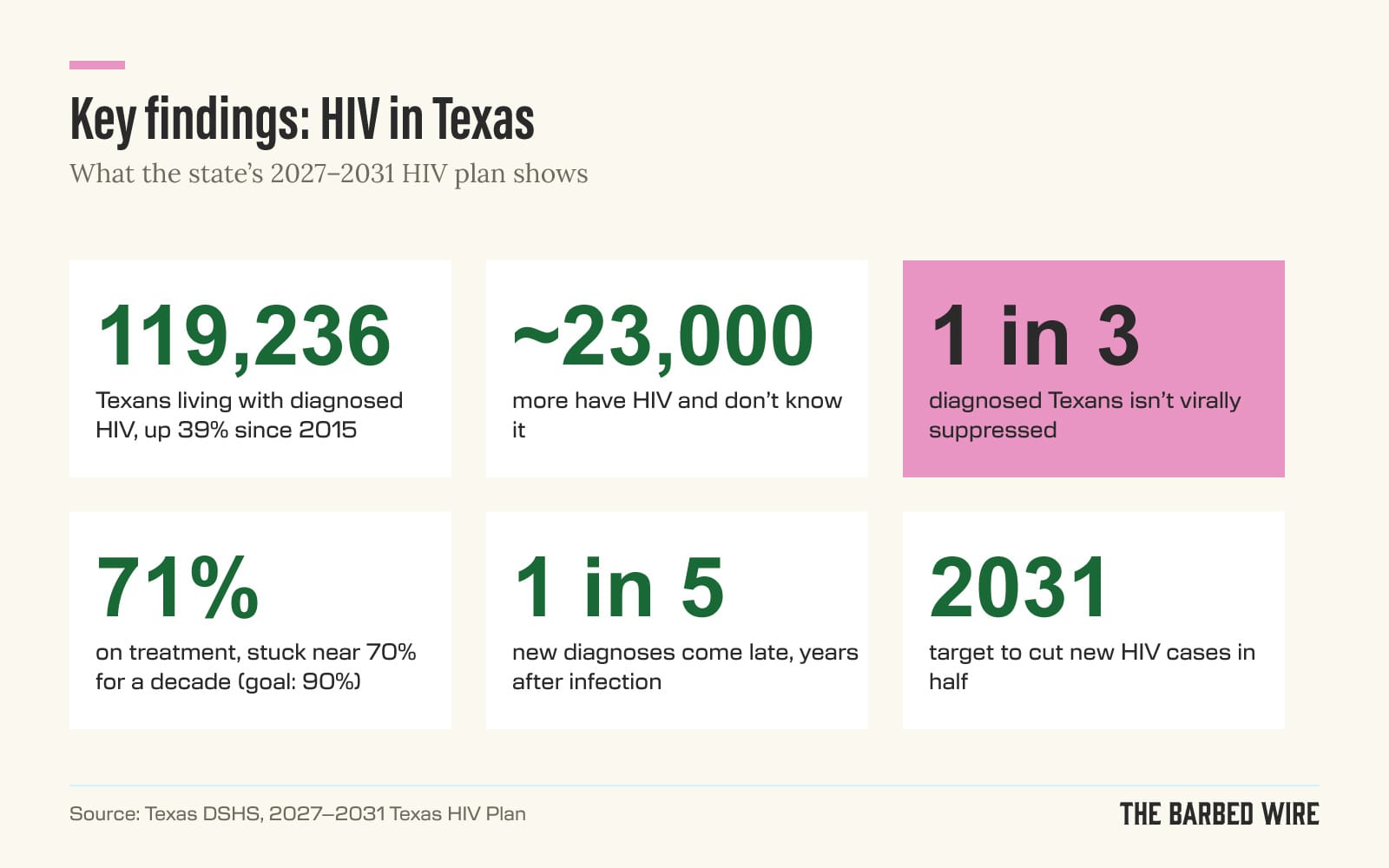
Published last month, the .pdf document outlines a five year plan, starting in 2027, to combat the spread of the HIV virus and ensure that people living with the illness are rapidly identified and able to access antiretroviral therapy. However, efforts to limit the spread of the disease and ensure those living with it have better lives face numerous potential roadblocks, from cuts to federal funding to attacks on the Affordable Care Act.
According to the DSHS, by the end of 2024, more than 119,000 Texans were living with HIV, an increase of 39 percent since 2015.
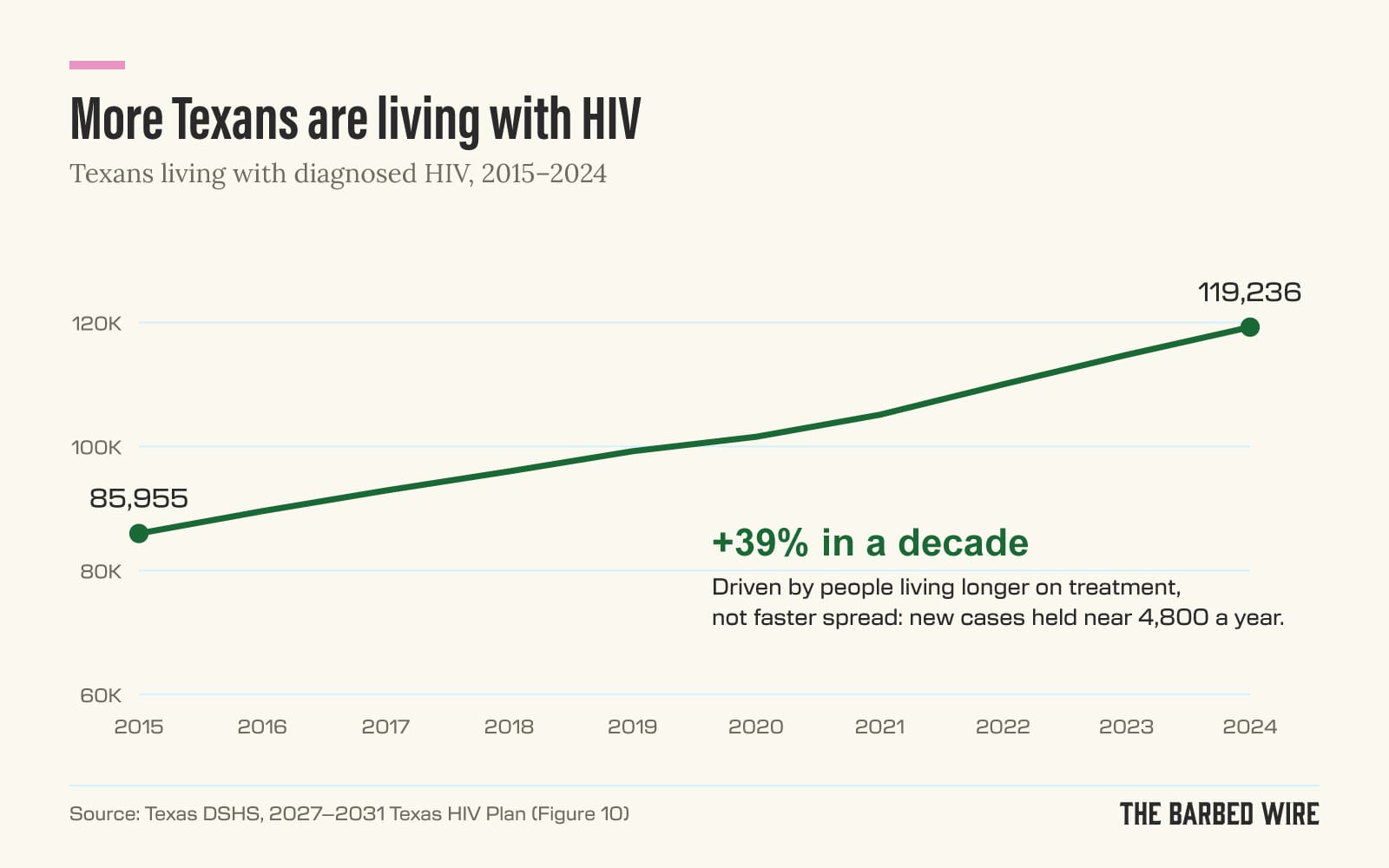
The report’s authors write that this is due to people living longer from better medications (i.e. antiretroviral therapy) versus a true increase in the spread of HIV. The widespread availability of pre-exposure prophylaxis or PrEP medications, which prevent people from catching HIV, have also transformed efforts to end the epidemic. But the plan also shows that the epidemic is far from over, and reveals that some people are still slipping through the cracks.
The Gaps In HIV Treatment
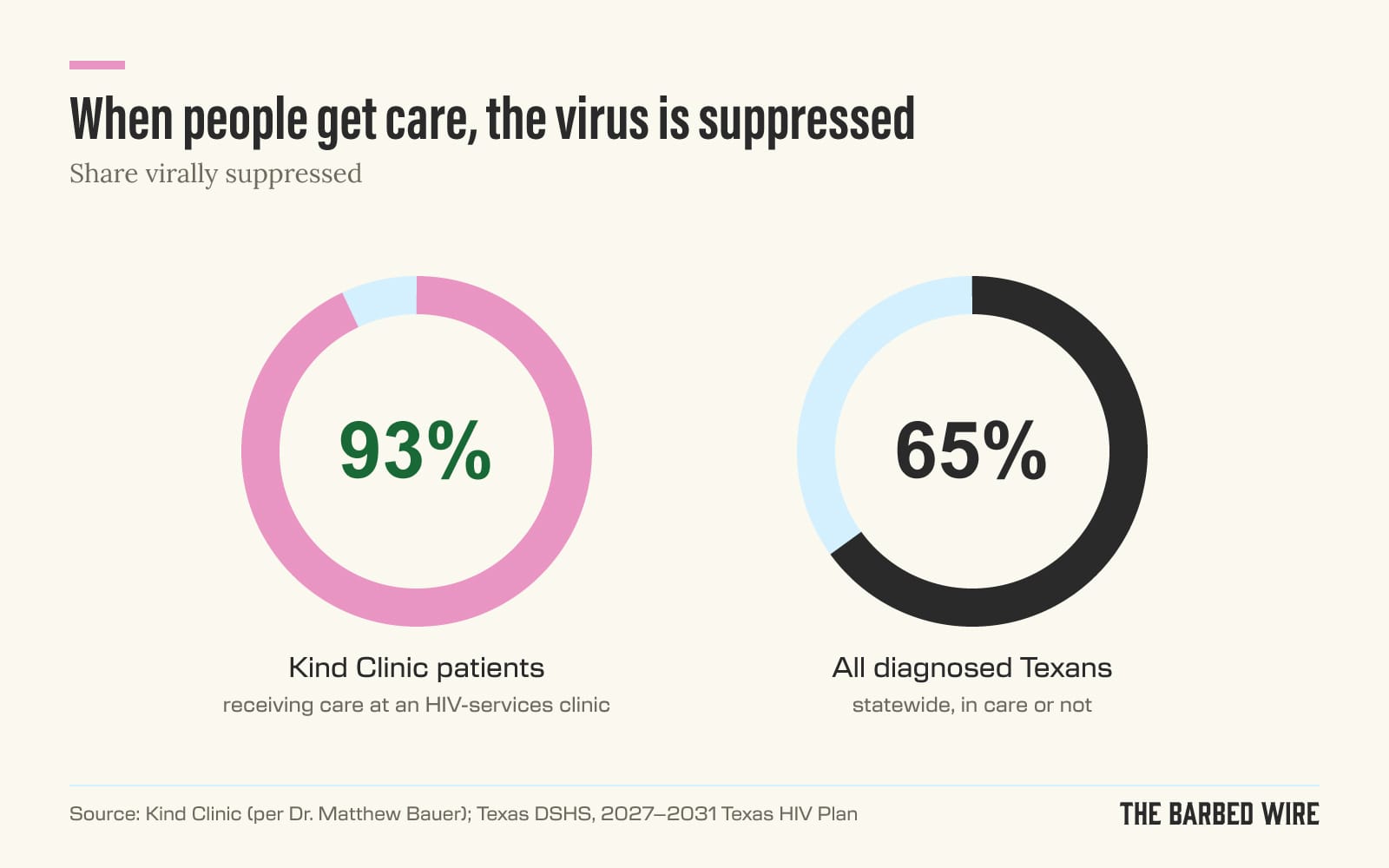
Dr. Matthew Bauer, chief medical officer at Texas Health Action and Kind Clinic, a nonprofit focused on HIV and sexual health, noted that there was still cause for concern in the report, even if it doesn’t show that HIV is spreading more rapidly than before. For example, only about two-thirds of people diagnosed with HIV are virally suppressed, meaning they’re still at increased risk of spreading the illness or developing symptoms of AIDS. (Editor’s Note: Kind Clinic, a program of Texas Health Action, is a supporter of The Barbed Wire. All editorial decisions are made solely by The Barbed Wire's editorial team with no input from Kind Clinic or Texas Health Action.)
“The gaps we're seeing here [are] getting people diagnosed, getting them into care, getting them on treatment, and keeping them in care,” Bauer told The Barbed Wire.
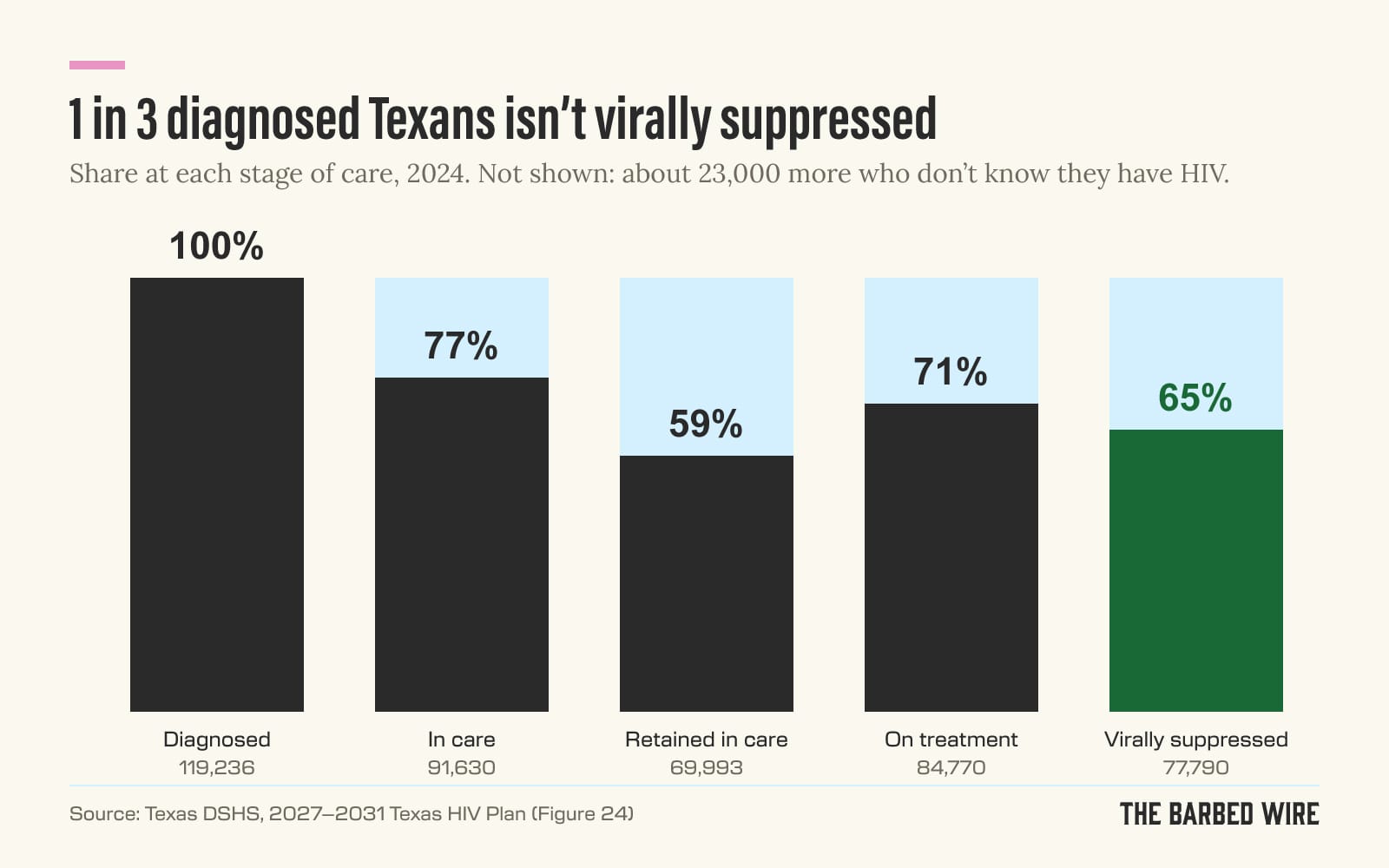
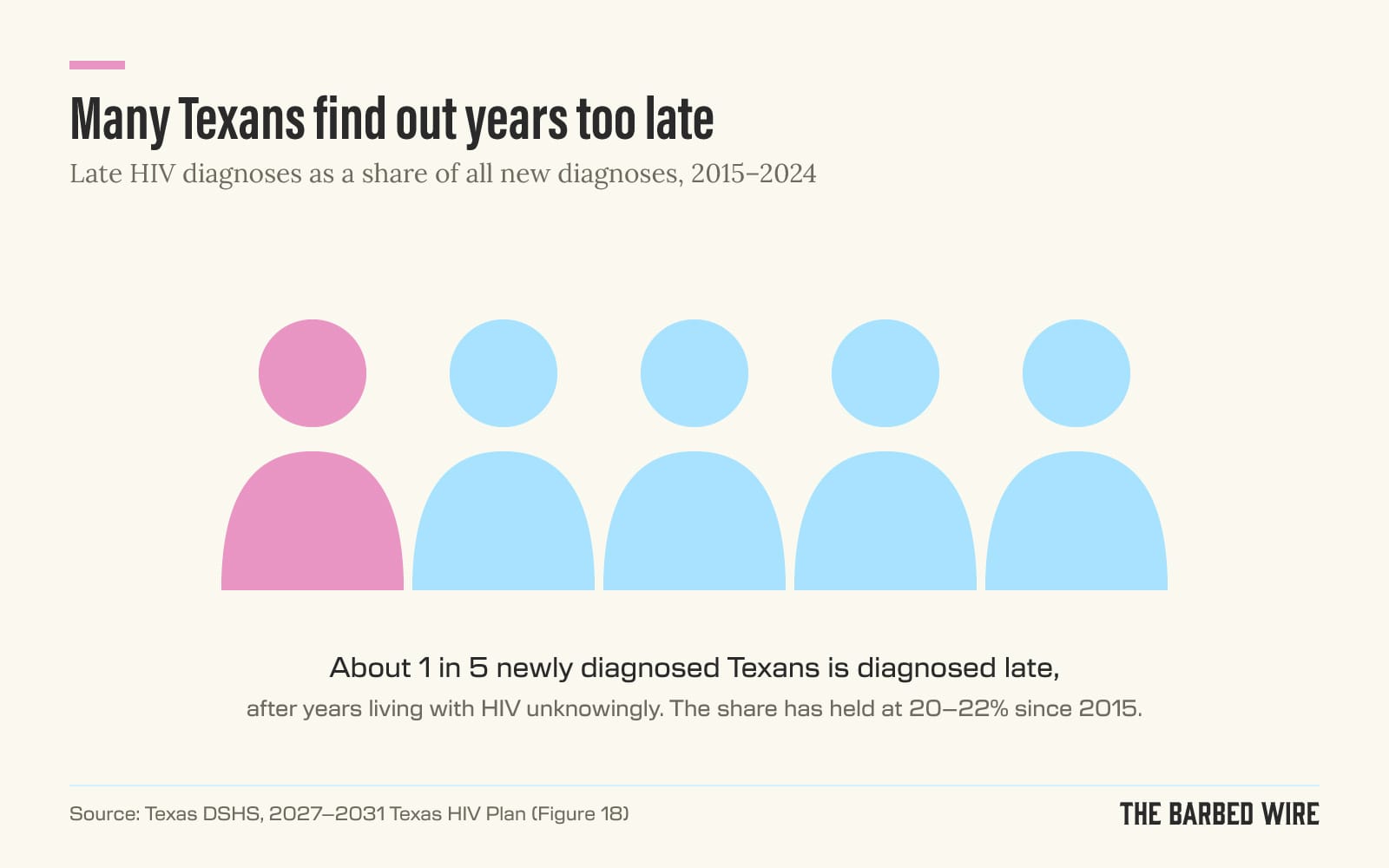
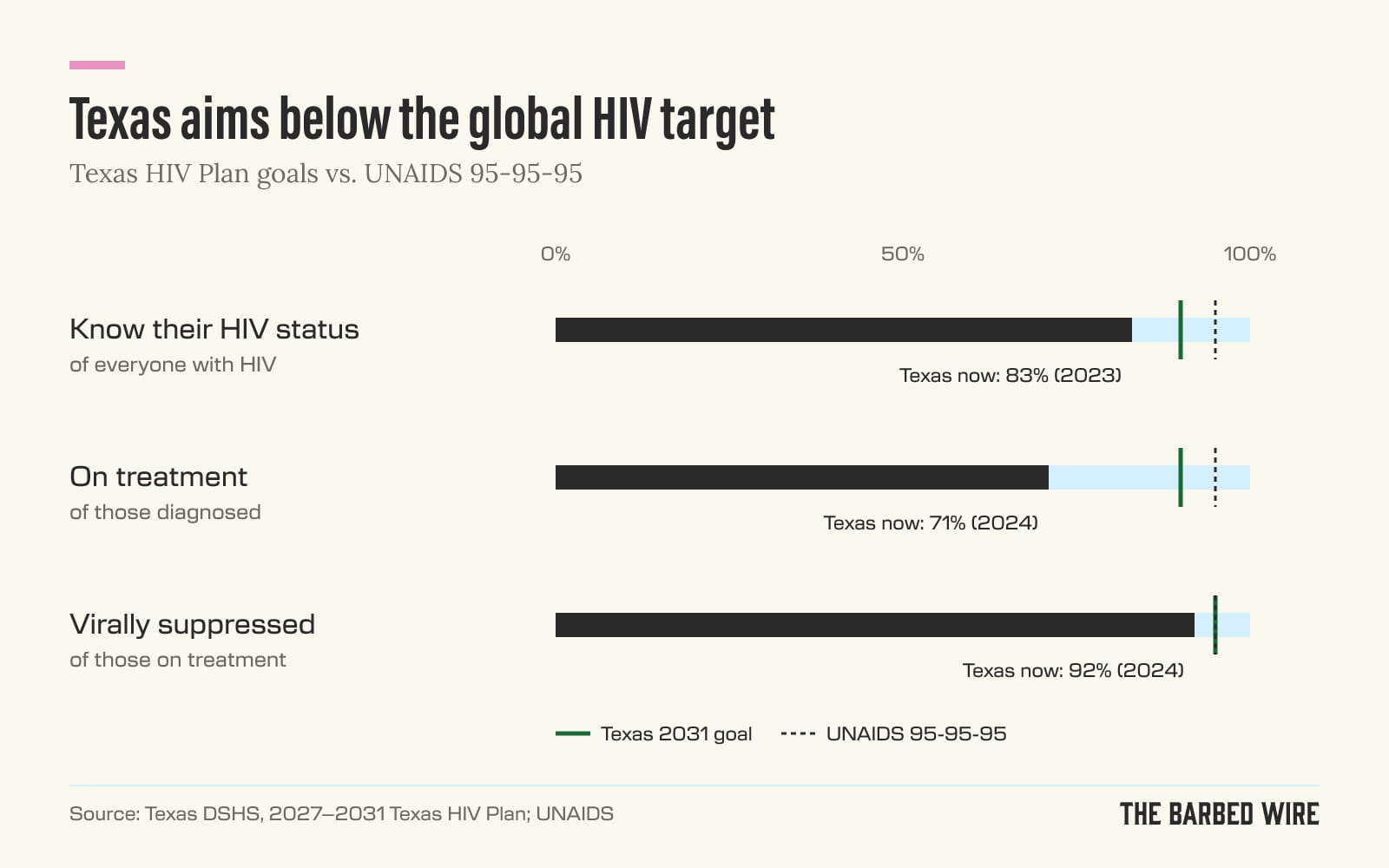
Another worrying statistic is that only an estimated 83 percent of Texans living with HIV knew their status, meaning approximately 23,300 people were living with undiagnosed HIV as of 2023, the last year for which data is available. Another statistic which raises concern for Bauer is how long patients may have had the illness before they were diagnosed:
“One in five newly diagnosed were actually not newly infected, meaning they'd been living with HIV for a long period of time before they got their diagnosis,” Bauer said. “That also tells me that they're not getting access to testing or other things that they may need in their areas, and they only get tested when they start showing symptoms in the later stages of HIV.”
When patients have access to an AIDS-services organization such as Kind Clinic, their prognosis can be dramatically different. Bauer said about 93 percent of the patients with HIV who receive services from Kind are virally suppressed.
With proper viral suppression, it’s all but impossible to spread the disease and life expectancies can be nearly comparable to those without HIV. “The medications work: they're highly effective in preventing HIV, but they're also highly effective in treating HIV,” Bauer told us.
Texas Falls Short Compared With Global HIV Policy
The new DSHS HIV plan was created through “extensive collaboration” with community-based organizations that treat HIV and AIDS patients, according to Chris Van Deusen, director of media relations for the DSHS.
“DSHS works closely with them because they are in the best position to understand the needs of their communities to connect people to HIV services,” Van Deusen wrote in a statement.
One of those organizations was Vivent Health, a national AIDS-services organization with offices in Austin. In an unsigned statement, Vivent officials noted that three members of their team were stakeholders in the development process. “Many of the plan’s priorities align directly with what we see every day as an HIV services organization.”
They also praised the plan for its emphasis on collaboration with community-based organizations. “Efforts must be tailored to the unique needs of local communities, ensuring services are accessible, culturally responsive, and designed to meet people where they are.”
However, Vivent noted that, while the state’s HIV reduction targets align with previous goals set by the U.S. government, the plan falls somewhat short of international standards such as the 95-95-95 plan endorsed by UNAIDS. That plan calls for 95 percent of people living with HIV to be aware of their status, 95 percent of diagnosed people be in treatment, and 95 percent to be virally suppressed by 2030.
By comparison, the DSHS plan calls for only 90 percent of people with HIV to be aware of their status, and for 90 percent of those people living with HIV to be in treatment. “Nevertheless, the plan outlines a clear framework for moving Texas closer to ending the HIV epidemic.”
‘Pitting The Resources Against Each Other’
Another challenge faced by many AIDS-services organizations is loss of federal funding and support. Recent reporting by the New York Times has described the current state of the United States Centers for Disease Control as a “zombified” shell of its former self.
When asked about cuts to federal funding, Van Deusen wrote that his department distributes, “approximately $51.6 million in federal and state funding” to medical providers and hospitals, but also community based organizations such as AIDS-services organizations.
But the DSHS report also acknowledges that investment in HIV mitigation hasn’t kept up with the times, Vivent officials wrote. “The plan acknowledges increasing financial challenges as the number of Texans living with HIV continues to grow while funding levels remain stagnant and, in some cases, have disappeared altogether.”
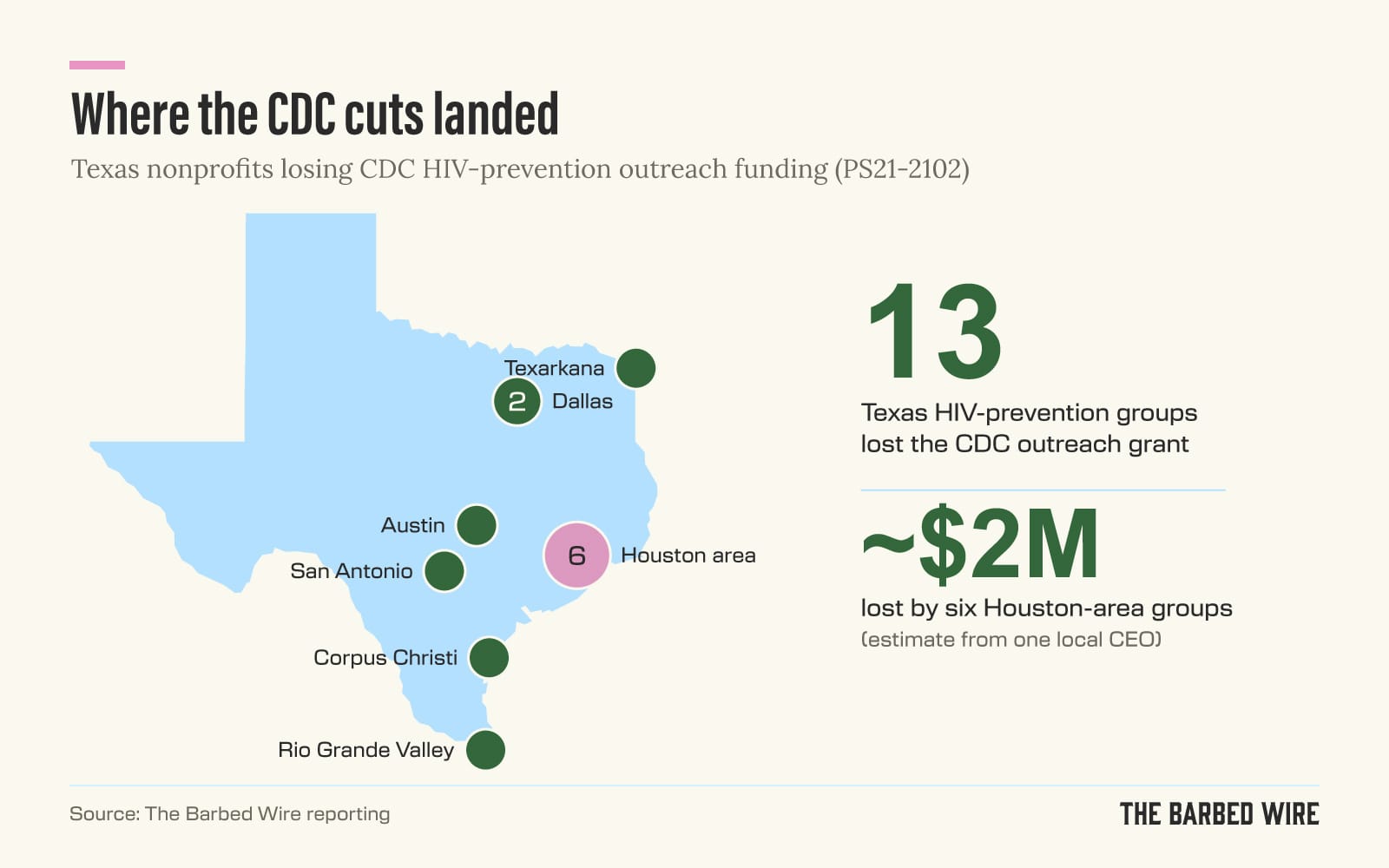
Last month, as reported by The Barbed Wire, the CDC ended a major HIV outreach grant, which our reporting showed would cost millions of dollars in lost funding to 13 Texas-based HIV-prevention orgs. In a separate interview, Emma Sinnott, vice president of health center operations for Vivent Health in Austin, explained that the funds not only helped the organization perform HIV testing and education at community events and gathering points, but also extended their reach through mail-in testing kits.
“People have it on hand in case [a friend says], ‘oh no, I think I caught something,’ and they're like, ‘hey, just take a test, and we'll go from there,’” Sinnott told The Barbed Wire. “It's also very handy for more rural areas.”
Sinnott said the CDC has promised to redirect the HIV prevention funds to state health departments, but it’s unclear when those funds will arrive or how they’ll be disbursed. The CDC did not respond to our requests for comment.
Sinnott also said that the move is likely to put different regions into competition for the funding.
“In a state like Texas, we have this rural-urban divide, and this is really pitting the resources against each other,” she explained.
Dr. Leo Moore, an expert on HIV treatment and men’s healthcare based in Los Angeles, told The Barbed Wire that recent cutbacks show that AIDS-services organizations can no longer depend on the federal government, but need to diversify to new revenue streams, and that private foundations need to step up.
“I get really concerned about administration to administration changes in HIV funding, and that it truly is at the whim of what the administration thinks is a priority,” Moore said. “I think that for many years we got comfortable, if I'm honest, because we just knew all the funding was going to come.”
The Trump Agenda
The state’s new HIV mitigation plan launches at a time that seems far more hostile to medical science, disease mitigation and the human rights of some of the groups most vulnerable to HIV, compared to even five years ago. The report notes that Latino and Black men who have sex with men are disproportionately affected, both when it comes to new HIV cases and the percentage of the overall population of those living with HIV. Reflecting national trends, Black women who had sex with men represented the fourth most common group of both new HIV diagnosis and people living with the illness.
But research of this kind has been widely suppressed by the federal government under the second Trump administration, and the report’s authors seem defensive against potential accusations of catering to diversity, equity and inclusion by highlighting these categories, noting that these groups are addressed simply in the name of “improving services and systems.”
“For example, knowing that high numbers of Latino men who have sex with men (MSM) have unsuppressed viral loads provides more information than knowing there are high numbers of men with unsuppressed viral loads,” the report continues.
The Trump administration has also injected its political agenda into the fight against HIV by instituting a policy that bans the use of a transgender person’s correct pronouns at any organization receiving funds from the Ryan White HIV/AIDS Program, probably the single biggest source of funding for HIV mitigation. The policy is the subject of an ongoing lawsuit by the LGBTQ+ civil rights nonprofit Lambda Legal.
Of this policy, Bauer said, “Anything that disrupts HIV care is a step backward in ending new transmissions and supporting people living with HIV.”
In their statement, representatives of Vivent also condemned the policy, predicting that it will have “harmful consequences for the health and well-being of Texans living with HIV and others seeking care that is consistent with evidence-based clinical standards.” However, they noted that “while we disagree with this discriminatory policy, we are committed to complying with the requirements tied to our federal funding.”
‘A Significant Drop’ In ACA Insurance Enrollment
Texas consistently ranks first in the number of uninsured residents, and trends suggest this is growing even worse after the federal government allowed key tax credits on Affordable Care Act health plans to expire. Based on the number of Texans who actually paid for their ACA healthcare plan, enrollment is down 4 percent compared with last year.
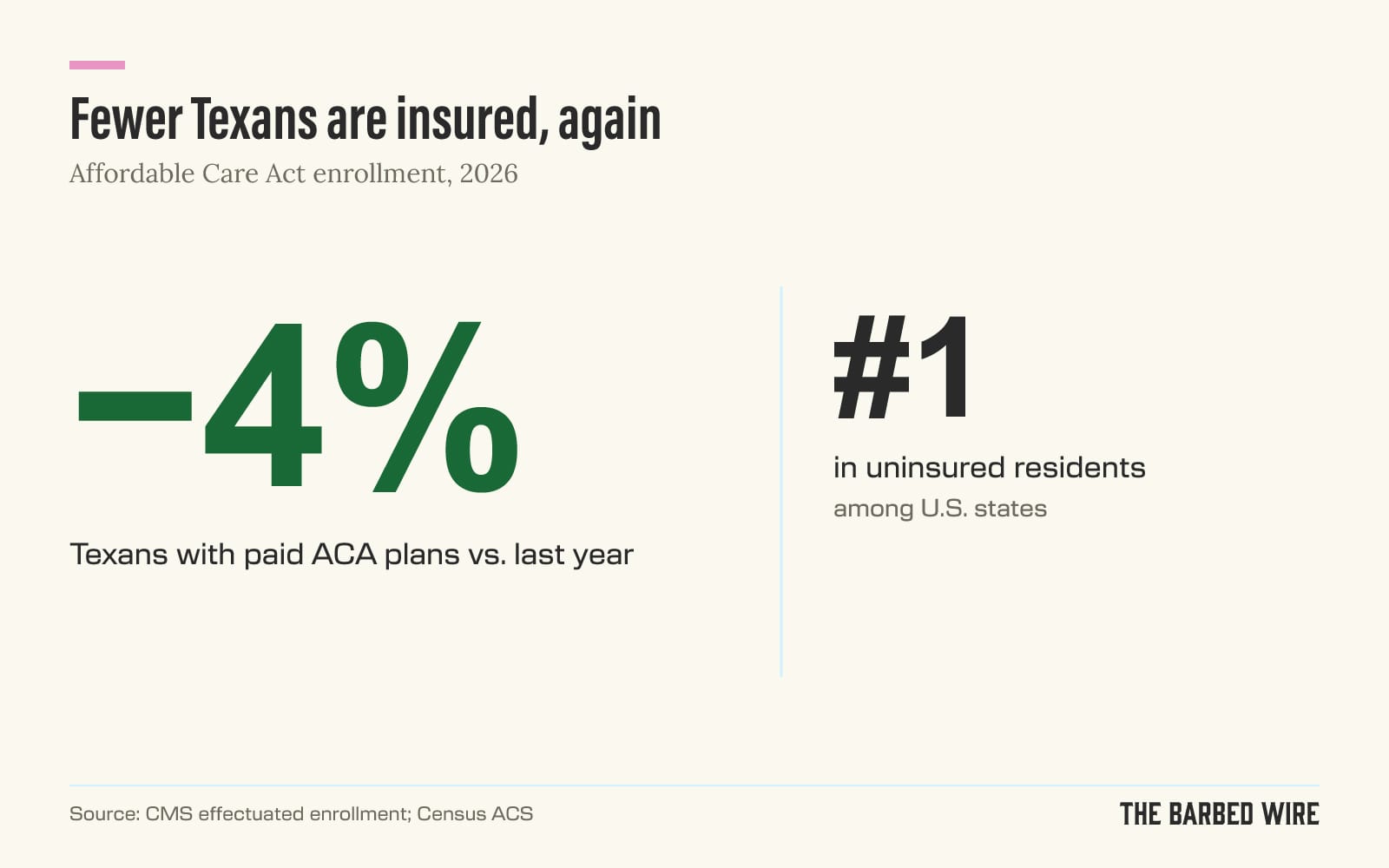
“That's a significant drop, and I'm sure we're going to see a continued drop as things kind of progress here,” Bauer said. Trump's so-called “Big Beautiful Bill” also added additional barriers to accessing ACA healthcare plans.
Vivent also raised the alarm about this dropoff. “As Texans lose health insurance coverage or face increased barriers to accessing care, the state's ability to meaningfully reduce new HIV infections and improve treatment outcomes may be limited.”
The U.S. Department of Health and Human Services has said that the drop in ACA enrollment was due to removal of 2.9 million people who were “fraudulently” enrolled in plans, a claim contested by healthcare experts who say rising costs are to blame. Mehmet Oz, head of the Centers for Medicare & Medicaid Services has promised to kick even more millions of allegedly fraudulent people off their plans in the near future.
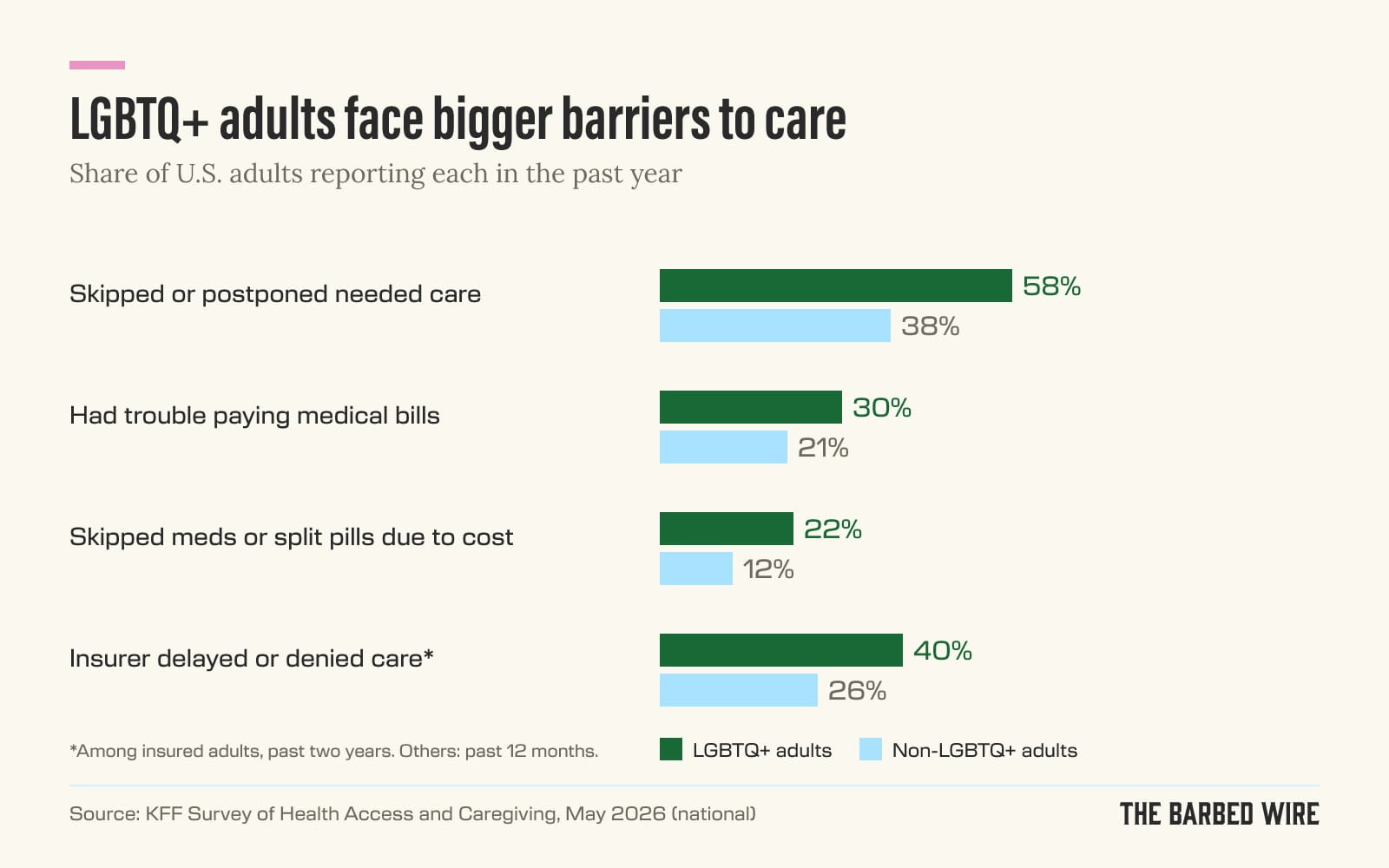
LGBTQ+ people already struggle to access healthcare, when compared to their straight counterparts. An August report by health policy institute KFF found that LGBTQ+ people “are more likely to postpone or skip needed care, forgo prescription medications due to cost, and struggle to pay medical bills.”
Accessibility is ‘Central’ To Beating HIV
“We are encouraged by the plan's emphasis on innovative and community-centered approaches,” Vivent wrote. But for the plan to succeed, a great deal more resources have to be made available to both state health plans and organizations like theirs. “While the roadmap is clear, achieving the goals outlined will require a level of investment and infrastructure that remains uncertain.”
In addition, HIV treatment alone isn’t enough to beat HIV. “If Texas is serious about reducing new HIV transmissions and improving outcomes for people living with HIV, investments in supportive services such as housing, transportation, behavioral health, case management, and peer navigation must remain central to implementation efforts.”
Dr. Bauer from Kind agreed that “access is central.”
“HIV is treatable and preventable,” he said, “but people need timely access to those services for getting testing, prevention, and affirmative healthcare.”